Beyond the plaque: the Green House at 174-176 King Edward Avenue
By Nancy Miller Chenier
In 1978, the City of Ottawa designated this one and a half stone double building with end chimneys and dormers as one of the few surviving stone cottages reminiscent of Ottawa’s origins with the Rideau Canal. In 2026, it is currently Lowertown’s only residential stone cottage and it does have strong connections to early and later work related to the Rideau Canal.
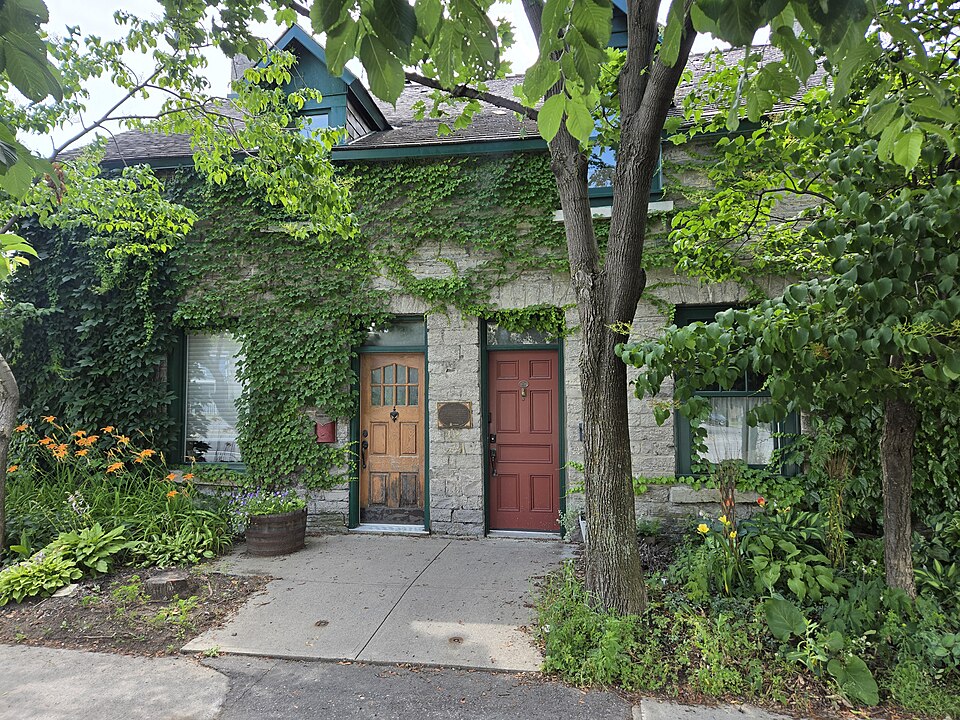
174-176 King Edward in 2025 (Photo: Earl Andrew)
For heritage designation purposes, the 174-176 King Edward Avenue plaque dates the building as pre-1870s. This presents a “history mystery” about its origins as its construction and other factors point to the 1840s in Bytown. The plaque notes that it is the Green House, not because it once had green doors and window trim, but because tax assessment records in the early 1870s place Patrick Green as the freehold owner.
Patrick Green did not live there but, over the years, rented the stone double on Lot 32, St. Andrew Street south to a changing list of tenants. In the 1860s, Patrick Green resided on the west side of King Street near Bolton Street with his wife Bridget and a growing family. Over time, he was employed in various jobs that took him to the mills at Green Island (the island in the Rideau River near the falls where Ottawa’s old city hall used to be located, the building now used by Global Affairs Canada). After Patrick’s death sometime in the late 1870s, his wife Bridget continued to live at 98 King until she moved to live with one of her sons at 600 St. Patrick Street. After her death in 1896, sons Michael and James T. Green, sold Lot 32 on the south side of St. Andrew to Joseph Gravelle.
The speculation about the Patrick Green who bought the stone building and the naming of Green Island continues to emerge in popular accounts. Harry and Olive Walker in their 1960s work, Carleton Saga, claim that: “The island derives its name from Patrick Green, a stalwart son of Ireland, who had a contract from Colonel By taking out stone for the construction of the Canal.” They reported that he lived near King Street and used the island as a hay field and pasture, perhaps even after Thomas McKay took a lease for the island in 1836.
The Walkers connect the Patrick Green of Green Island to living descendants that are grandchildren of the Patrick Green who at one time owned the stone cottage at 174-176 King Edward. The census of 1851 may support this connection as Patrick Green was then 35 years of age. This means that during the construction of the Rideau Canal, he could have been one of the young unskilled labourers paid on a daily basis to haul away the rocks and soil around the construction sites. When the Rideau Canal opened in 1832, he was 16 years of age.
However, it is the name McDermott on a map dated 1851 that provides a valuable clue to the origins of this building. The map shows the McDermott name on a structure of similar proportions and site position. In 1843, the Vesting Act granted the ability for Ordnance land and lots to be purchased with deeds of ownership and a survey of St.Andrew included this Lot 32 at the corner of the then King Street.
Michael J. McDermott married Catherine Fitzgerald in 1843 in Bytown. According to
McDermott’s autobiography published in his 1879 guide titled The Civil-Engineer & Surveyor’s Manual, McDermott was born in Ireland and after working in Ireland and England, he sailed to Canada in 1842. By 1844, he was recertified to meet local standards. He then surveyed for the Crown in Bytown and worked with the British Board of Ordnance on several canal-related projects. The first McDermott child was born in Bytown, perhaps in this house. By 1850, the McDermott family had moved to the United States, first to Milwaukee and then to Chicago.
An Ottawa Citizen reminiscence by a former student suggests that after McDermott left Bytown, the building was adapted for use as a school with a teacher called Patrick Monaghan. The teacher reportedly taught about 60 students from ages five to 25 years. Like other teachers of the era, he disciplined using a raw-hide whip, a corrective instrument easily replaced from a harness store if students tried to purloin it.
In 1863, the Building Society of the District of Dalhousie advertised Lot 32 on the south side of St. Andrew and fronting on King Street for sale. This suggests that McDermott may have used the Society to assist in purchasing the property and in covering construction costs for the building. Perhaps when McDermott left Bytown, he defaulted on payments to the Society and this is when the Green family took possession.
This substantial stone double at 174-176 King Edward Avenue is one of Lowertown’s oldest buildings. Its storied link to Colonel By’s Rideau Canal, to early Irish families, and to the development of Ottawa provides a significant connection to Lowertown’s rich history. Whether called the Green House or the McDermott House, this heritage building stands strong as a rare physical reminder of the work of early residents in this community.