Books by or about Lowertowners
Brian Doyle Angel Square, Groundwood Books, Toronto, 1984.
By Nancy Miller-Chenier
Brian Doyle is legendary and when he died earlier this year, Lowertown lost one of its most beloved and renowned story-tellers. Doyle’s novel, Angel Square, takes readers into the life of Tommy, pseudonym Lamont Cranston, alter ego of The Shadow, a crime fighter based on a radio series. In reality, Tommy is a 10-year-old boy, living with his family on Cobourg Street in December 1945. The narrative travels with Tommy as he works to solve the mystery of the violent anti-Jewish assault on the father of his friend, Sammy Rosenberg. Sammy’s father worked at the Cobourg streetcar barn as a night watchman and was seriously wounded by a man wearing a hood made from a Ritchie’s Feed and Seed bag.
Imagine you are Brian Doyle who lived with his family at 32 Cobourg in circumstances similar to that of Tommy. The book very firmly places the main character in the Lowertown of 1945. Tommy’s house has two storeys, a brick exterior, and a coal burning furnace in the cellar. Tommy eats Quaker Oats for breakfast, listens to programs like “The Shadow” on a radio with tubes, and feels the house shake when the streetcars rumble past to go to the car barn, now the site of Macdonald Manor at
110 Cobourg.
Tommy’s friends live nearby and represent the major religious and cultural groups inhabiting Lowertown in the 1940s. Sammy Rosenberg is Jewish and like Tommy, attends York Street school, Gerald Hickey is Irish Catholic and attends St.Brigit’s School of the Bleeding Thorns, and Coco Laframboise is French Catholic and attends the School of Brother Brebeuf. Although Tommy is the key detective, these friends from diverse religions and ethnic backgrounds work together to solve the crime.
Tommy travels widely throughout Lowertown and other parts of the city. If the reader wants to walk a little with Tommy in the Angel Square area, start on Cobourg and travel to the southeast corner of Jules Morin Park, formerly Anglesea Square. Close to this location, currently under the weathervane with the angel and building silhouettes, Tommy and Sammy would risk multiple physical encounters with terrifying gangs of Irish, French, and Jewish school boys as they walked to and from York Street school. When Tommy takes a side trip to Sammy’s home after school, he cuts up Heney Street to the apartment building beside the car barn, possibly 122 Cobourg.
Tommy identifies the man who committed the brutal crime as Mr. Logg, a car barn mechanic who lives in the apartment building at the corner of Clarence Street and Cobourg, a place like 60 Cobourg. Under the guise of selling comics to Mr.Logg, Tommy finds the incriminating hood and then writes messages to all the surrounding neighbours identifying Mr. Logg as the assailant. As the neighbours gather outside the apartment building, Tommy climbs the corner hydro pole holding the hood as evidence.
Doyle’s Angel Square is fictional but draws on the reality of Lowertown’s history as a starting place for people from varied backgrounds experiencing different, often difficult lives. The novel touches on diversity in family relations, economic circumstances, and individual ethics. While acknowledging the very real tensions that existed among French, Irish, and Jewish communities in the 1940s, the novel builds a scenario where young people with divergent backgrounds work together to solve a racially motivated crime. The novel is classified as juvenile fiction, but Angel Square has a universal message for readers of all ages in diverse cultural groups about how a community can work together to expose prejudice and fight for justice.
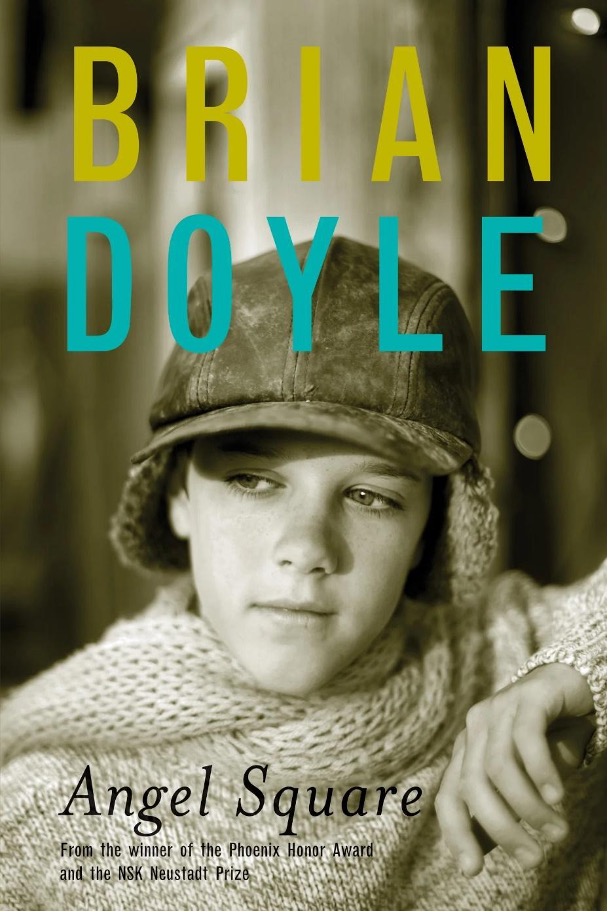
Brian Doyle, Angel Square, 2004 edition published by Groundwood Books, image from House of Anansi Press.