Pothier House recognized with city heritage award
By Curtis Wolfe
The City of Ottawa’s Heritage Award of Merit for Restoration has been awarded to Matthew Villeneuve and Isabelle Leclerc-Morin, co-owners of Pothier House at 207 Cathcart Street, for their work in restoring the building’s two-storey porch. The award recognizes projects that restore a heritage property to its original form and overall character, preserving its historical integrity.
The restoration project involved repairing and rebuilding the porch’s supporting structure, railings and roof as well as decorative elements such as its galvanized finials and corbels, thus preserving the home’s historic architectural character within the Lowertown West Heritage Conservation District (HCD).
The award’s jury characterized the project as an excellent example of restoration on a small building. They commended the overall quality of the work, with particular praise for the careful
reinstatement of a period-appropriate railing, and noted that many comparable homes are being lost in Lowertown and across the city. The restoration work was supported by the city’s heritage property grant program which assists property owners in restoring heritage buildings.
In 2022, an initial restoration effort was interrupted when a well-known construction company abruptly became insolvent, leaving multiple client deposits unaccounted for across the city and prompting investigations by Ontario’s Home Construction Regulatory Authority (HCRA) and the Ottawa Police. Villeneuve and Leclerc-Morin then asked contractor Paul Denys of Denys Builds Designs Renovations to take over the work, which was completed in 2023.
Denys said the restoration work focussed primarily on what remained of the porch’s original structure. He replaced its railings and columns on both the first and second floors with custom-made replicas of the originals. Additional elements, including the crown moulding, soffit, and fascia, were also reproduced to match the historic design.
As with many renovation projects, the work presented some logistical challenges. Particular care was taken to protect an existing apple tree throughout the process, and to avoid hitting water and sewer pipes when installing new helical piles for the porch footings.
The home was originally constructed around 1903 on a previously vacant lot. Among the early residents was Alfred Laframboise, a clerk at the Department of Public Works, his wife Alma, and her father Wilfrid Cousineau, a motorman in the city’s electric streetcar system.
However, the house is most closely associated with one of its longest residents, Louis-Camille Pothier, a well-known Ottawa civil servant who died in 1938 at the age of 73. Born in Sorel, Québec, Pothier moved to Ottawa in 1885 to work for the Government Printing Bureau and later the Civil Service Commission. He was also actively involved as a parishioner of Notre Dame Cathedral and participated in several Catholic organizations.
Despite the complexities often associated with such projects, Villeneuve described the city’s heritage permit and grant application process positively. “Everyone we interacted with from the city’s heritage group were wonderful, enthusiastic, and helpful throughout the process,” Villeneuve noted, adding that the application was “relatively straightforward” and that grant funding was delivered as expected upon completion of the work.
At the same time, navigating the various other aspects of the process could present challenges.
“Different departments in the city do not seem to speak with each other, much less coordinate,” he said, pointing to some difficulties aligning requirements among the various heritage planning, permitting, and inspection processes.
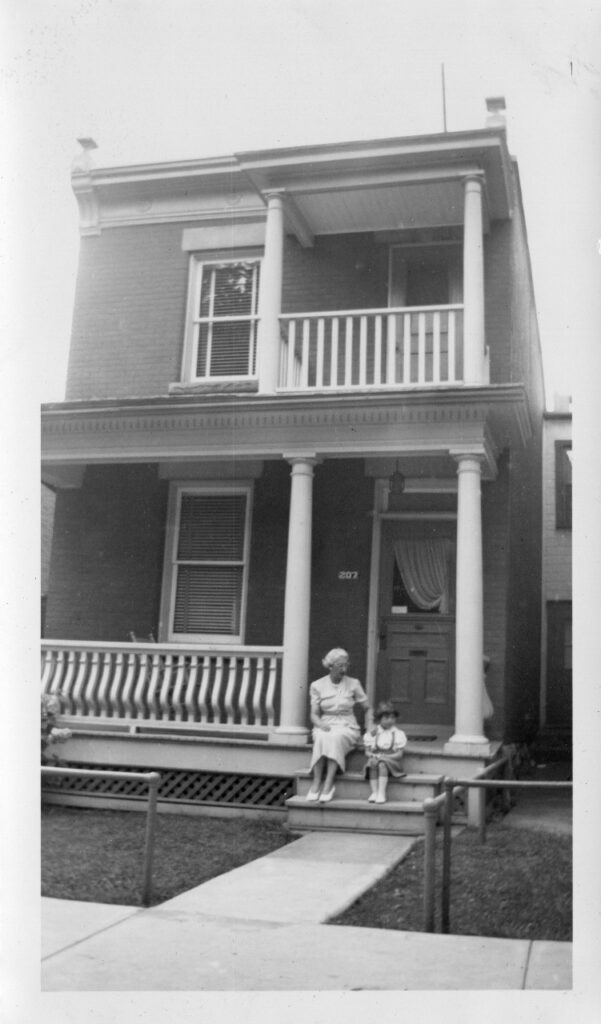
207 Cathcart in the mid-20th century. (Source: Dostaler Family Collection / Marc Aubin)
Reflecting back on the experience, Villeneuve advises other homeowners to anticipate administrative hurdles and to proceed carefully when selecting contractors. He also recommends taking advantage of the opportunity to address related infrastructure issues during restoration work, noting that “if you’re going through the trouble of redoing the front porch, it’s worthwhile to replace any lead water lines while in there.”
Villeneuve acknowledged that the city’s grant program played a key role in shaping the project. “The availability of the city’s grant program was definitely a deciding factor in choosing to undertake a detailed restoration. A major overhaul of the deck was absolutely needed, but without the financial assistance of the city we would have been limited to a full rebuild with basic contemporary materials and design, losing detailed elements like the ‘pregnant lady’ balusters, dentils and the tin-work finials that really projects the historic character of the house.”
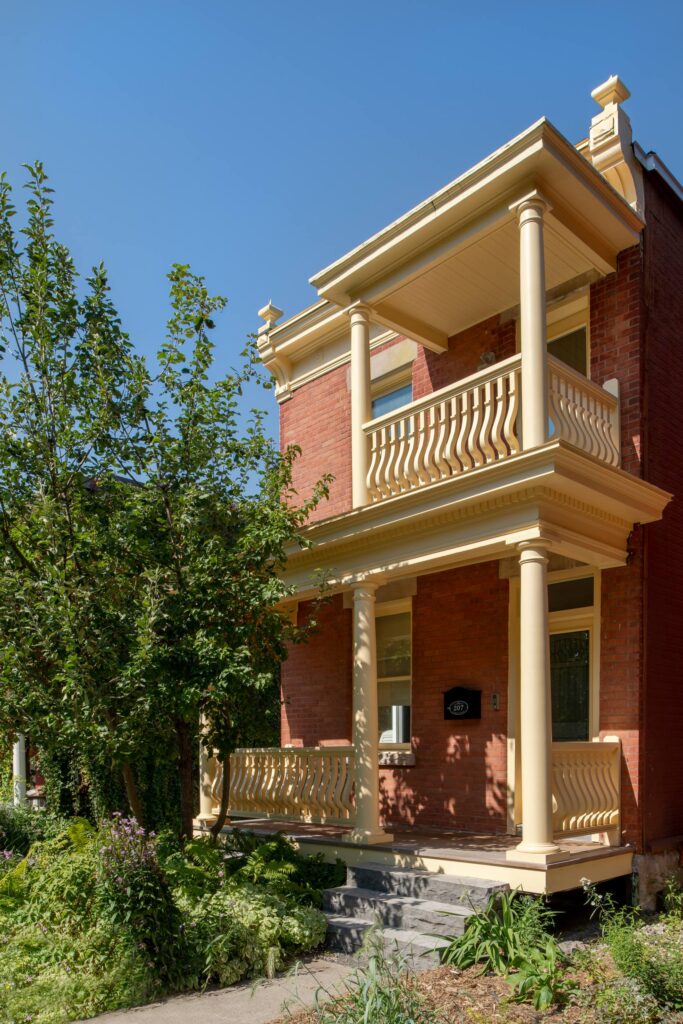
207 Cathcart following completion of the porch restoration. (Source: Gordon King)