Bytown: built by water
By Josiah Frith
Ottawa stands on the unceded, surrendered territory of the Anishinabe Algonquin Nation, who continue to live, govern, and care for these lands and waters today. I offer these reflections in the spirit of learning, reconciliation, and shared stewardship.
I write as a long-time resident of Lowertown, part of the historic heart of Ottawa, where I have lived and worked for more than half my life. As a hairstylist, parent of two children under thirteen, business owner, and a member of the executive of the Lowertown Community Association, I’ve come to see this neighbourhood not as static history, but as a living confluence of time, culture, and care – a place where the past and present flow together like the meeting of rivers.
The three rivers that shaped Bytown – the Kichi Zìbi (Great River, Ottawa River), the Pasapkedjinawong (the river that passes between the rocks, Rideau River), and the Tenàgàdino Zìbi (the river that stops one’s journey, Gatineau River) – are more than geography. They are time itself made visible, each current carrying memory downstream. For thousands of years, the Anishinabe moved along these waters, trading, gathering, and holding ceremony. The flow was cyclical and reciprocal – a living rhythm between people and place.
When settlers arrived in 1826 to build the Rideau Canal, they entered a river already in motion. The settler’s current – driven by ambition and industry, swift and loud – met the calmer, unhurried one, and the waters didn’t simply merge. They churned. The story of Bytown began in that turbulence: two currents, two perspectives, colliding. One saw the river as a living presence, the other as an obstacle to be crossed.
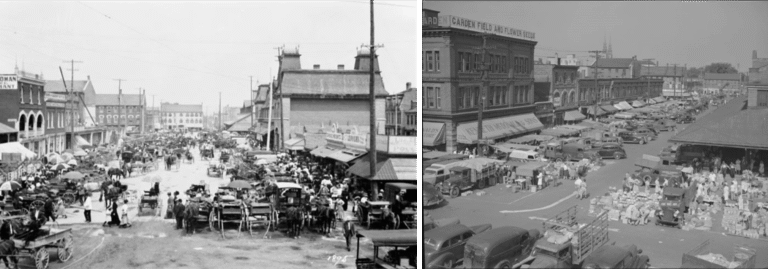
Lowertown was carved in that confluence, a place of eddies and undertow – workers’ homes along the muddy banks, families from many lands swirling together in search of footing. My own house, built in 1872, still bears that memory. It’s first residents walked to the Bywash or the Rideau River to fetch their water. Soon that water became too polluted, and they were sold barrels of water brought in by horse and wagon. When the city finally dug trenches and installed lead pipes, the water’s voice moved underground – captured, redirected, made obedient. What had once been drawn freely from the current was now measured by meter and bill. Convenience and commerce replaced connection.

(Photo: Library and Archives Canada, C-011047)
Time, like water, doesn’t stop to be studied. It carries everything forward — stories, mistakes, silt, and seeds alike. Each generation adds its own layer of sediment. The industrial current of Bytown hardened into the bureaucratic city of Ottawa, its early channels straightened and paved. Yet, in the pipes beneath every street, the old waterways still whisper. The rivers are still there, still moving, still remembering.
In Ottawa, the currents are beginning to turn again. The rivers that were once too polluted to touch now run clean enough to swim in. Fish and birds have returned. This is the work of many hands – the Anishinabe Algonquin Nation, whose teachings about respect for the water have re-entered planning and policy, the Ottawa Riverkeeper, whose community programs monitor and protect the watershed, volunteers in the Rideau Canal Adopt-A-Shoreline initiative, and the rowing and sailing clubs that continue the city’s long relationship with the water. Together, they remind us that stewardship isn’t nostalgia – it’s a daily practice.
Bytown’s currents – Indigenous, colonial, immigrant, modern, and traditional – are still meeting, sometimes swirling, sometimes boiling, always reshaping the riverbed of this city. Lowertown, nestled where those currents converge, remains a place of arrival and renewal. The ByWard Market still hums with the energy of exchange, and the Alexandra Bridge, soon to be rebuilt through consultation and collaboration with local Indigenous communities, offers a chance to connect not just two provinces, but multiple ways of understanding our shared waters.
Time itself flows like water. It loops, bends, erodes, and restores. The city we call Ottawa is not fixed in stone – it’s a channel carved by centuries of movement. The rivers that built Bytown have carried us this far – through conflict, change, and rediscovery. Their message endures: that strength lies not in stillness, but in the capacity to move together.
Our currents still meet here, as they always have. The question is whether we will remember how to flow together.