A French-Canadian Austrian in Lowertown! – The Finks
By Marc Aubin, with input from a book by Maurice Fink
Special thanks to Jeannine Fink, Lynda Fink, and Nicole Davis-Lafrenière
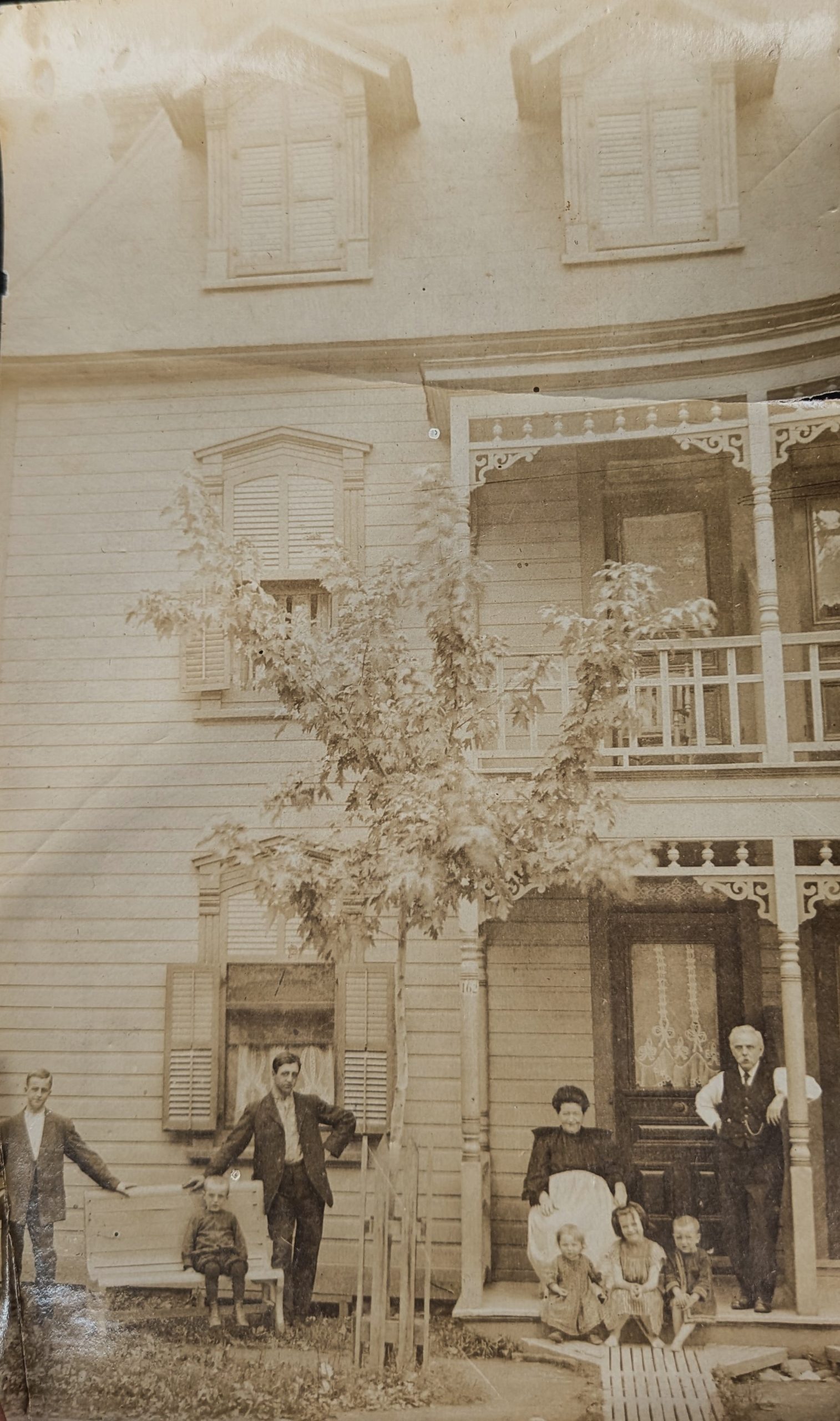
This story and this photo of 162 Bolton Street, which has now been donated to the City of Ottawa Archives, was precipitated by the death of Jeannine Kennedy Fink in 2025. Jeannine was a great granddaughter of the first Finks to arrive in Ottawa, and both she and her brother, Maurice, had a keen interest in researching and preserving their family history.
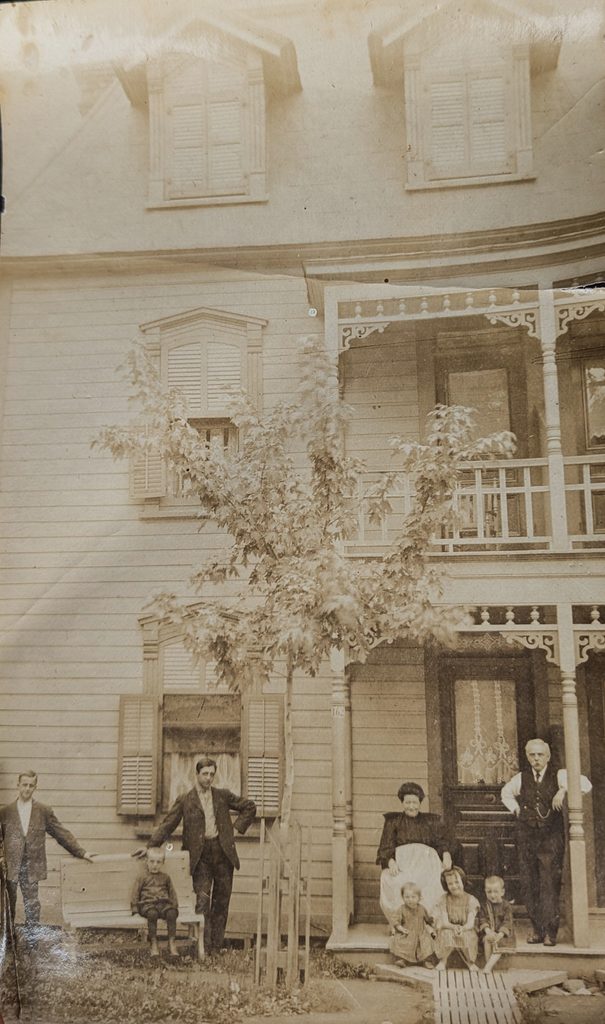
Photo credit: Fink-Lafrenière family
I met Jeannine in the late 2000s when I moved in at 100 Boteler Street. Jeannine and I volunteered together to organize one of the building’s first Christmas parties, which continued on for many years after we first launched it. We also exchanged much on her family history. When she died, I took it upon myself to further research the Finks over the next year into 2026. The Fink family was very generous with their time and shared genealogy, histories, memories, and photos with me.
The Fink family has been in the Lowertown area since the 1850s and was described as a pioneer French-Canadian family of the city. Jean-Jacob Fink (1820-1882) was originally from Lingenau, Austria. He came to Joliette, Quebec, and was married to Éléonare Lahaie, and by second marriage to Esther Campeau (1825-1908). The second marriage took place at Ottawa’s Notre Dame Cathedral, placing their arrival in Ottawa to around the 1850s. Jean-Jacob was a master plasterer and was referred to as an important contractor who had worked on a major upgrade to Notre Dame Cathedral in 1878.
One of their children, Léon Fink (1864-1928), lived for many years at 162 Bolton Street with his wife, Lucie Forcier (1863-1939). They were both born in Ottawa and married in 1885. They had 19 children, of which eight (six?) survived to be adults (Léon, George, Parmélia, Amélina, Albert, and Charles). Finks and their descendants lived on Bolton Street as early as 1901 and until the 1960s.
Léon was briefly co-owner of Fink and Malette on Dalhousie Street, and later a manager at the J.A. Faulkner department store, also on Dalhousie. After that, he worked at the National Printing Bureau on St. Patrick Street near Sussex Drive. Lucie was a member of the Ladies of St. Anne Parish, the St. Élizabeth Society of the Precious Blood Convent, and a patron of the St. Joseph Orphanage. They had eight children: Henri (1893-1966), René (1902-1976), Léon (1886-1963), Colombe (1901-1944), Oneïda (1889-1980), and Alice (1895-1980).
Around 2003, George, a grandson of the earlier Léon Fink (1864-1928), wrote an unpublished memoire and included the following in the introduction: Why write my autobiography? To leave a heritage to my children, grandchildren, and other generations. Share with them my life experience and explain to them the world in which I lived. What it was like to be alive in a world before jet planes, free trade, globalization, and the Internet.
George described his parents, René Fink (1902-1976) and Alexina Bédard (1903-1975), where they were born, and their temperament. She was a great amateur musician and loved to read the daily newspapers from Ottawa and Montreal. His father was very sociable and generous with his time, volunteering on the administration for the Amicale Guigues and Senior Lacrosse League of Ottawa. Like his father Léon once did, René worked for a department store, A.J. Freiman’s on Rideau Street, and later for the federal government. He was big amateur player of lacrosse and softball and often helped organize parties at Bingham Park.
He also wrote about his siblings. His sister Denise (1931-2002) remained single all her life, working 43 years for the federal government, and was a fan of skiing and travel. His sister Jeannine married in 1973 to John Allan Kennedy, only for him to die a year later in 1974. She was also a fan of skiing and travel, and had worked at the National Research Council, Radio-Canada, and the House of Commons. Neither had children, but spoiled their nieces and nephews, Lynda, André, Diane, and James, as well as their grand-nieces and nephews, Mélanie, Jason, Simon, Marie-Anne, and Caroline. Maurice was the last child after George, and worked in optometry, aviation and the federal government. He was a lacrosse and hockey player. He was married to Anne Gravelle and had two children, Lynda and Simon.
Growing up, George notes that they lived at 84 St. Andrew Street in the early 1930s and at 34 Bolton Street in the later 1930s, then at 32 St. Andrew, then back to the family home at 162 Bolton, where his aunts Oneïda and Éva lived in the back. He wrote of how Lowertown and Notre-Dame Parish were like a French-Canadian village within Ottawa. He said the neighbourhood was considered poor by material standards, but that its true pride was how its residents enriched the area.
George wrote of how they played at Bingham Park up the street, skating, playing in the sand, and on the swings. He also recalled a popular Lowertown game called “Tin Can.” The can would be placed in the middle of the street and everyone would hide. One person was “it” and, upon finding someone hiding, had to get back to the tin can in time to kick it. If the person hiding kicked the can first, then they avoided being “it.”
George’s book is a great source for all the common experiences of the people who lived in Lowertown. It included memories and mentions of the schools, institutions, getting his first bike, raising children, sports, being a grandfather, work (Radio-Canada), and volunteering. In 1999, he was honoured with the Antoinette-Robidoux Award, given by the Centraide of Greater Montreal to recognize his exemplary and exceptional volunteer work. It recognized 40 years of volunteering, leadership, and a selfless devotion to a social cause. He had led a project – Le Comptoir du P’tit pro – that gave sports equipment to underprivileged children.
Jeannine’s presence is greatly missed at 100 Boteler Street, so I hope this little story honours her and her family’s history here in Lowertown.