Beyond the plaque: Ottawa’s First Children’s Hospital at 197 Wurtemburg Street
By Nancy Miller Chenier
The plaque on this building, now the Turkish Embassy, features the Children’s Hospital, one of the significant early occupants.
In June 1889, local reporters heralded the opening of the Children’s Hospital with headlines like “For the Little Ones” and “A Pretty Little Nest.” Early descriptions indicated a ground floor apartment for the nurses, a kitchen, and a children’s ward with ten small beds. The upper level had bedrooms for private patients, a bathroom with modern conveniences, and an operating room.
At the time, Dr. Adolphe Robillard, the city’s medical health officer reported regularly on the high number of childhood diseases and the subsequent mortality rates. In 1886, the Anglican women of the Ministering Children’s League (MCL) acted on the growing concerns for children’s health initially by establishing facilities in private rented spaces and then finally moving to Wurtemburg Street. From the beginning, they promoted the work as nondenominational with children admitted free of charge.
The women who took on the hospital’s charitable duties were members of the city’s elite, connected through wealth and influential family ties. Mrs. Grant Powell, the former Elizabeth Hurd, daughter of Samuel Hurd, once surveyor general for Upper Canada, frequently filled the role of MCL President and had already demonstrated her leadership through executive and organizing positions connected to St Alban’s Church. Mrs. William A. Allan, the former Alice Maude Sherwood, daughter of Henry Sherwood, onetime Attorney General of Upper Canada, also served as President and, like Powell, had grown up in Toronto in a family aligned with the key political figures of the day.
From the start, the MCL executive members were innovative. They employed the first formally trained nurses in the city. While their primary goal was to hire nurses for bedside care in the hospital, they also provided nurses for daily home visits in the community, a practice that preceded the establishment of the Victorian Order of Nurses in 1897.
Who were these trained nurses? Florence Cottle, the first “Lady Superintendent,” had graduated from the earliest Canadian nursing school based on Florence Nightingale’s principles – the Mack Training School for Nurses in St Catherine’s. Before Cottle came to Ottawa, she had served as a military nurse in the Northwest Rebellion and then worked at the London General Hospital.
Other nurses that followed Cottle were also nursing school graduates, most from Canada, some from the United Kingdom or United States. They were willing to travel and seek new experiences. Alice Stone, graduate of the Edinburgh Nursing School and the Manchester Royal Infirmary, had a specialization in home nursing. Minnie Affleck from Middleville near Ottawa and a graduate of Kingston General Hospital was among the first group of military nursing sisters to serve in the Boer War. Margaret Jemmett from Hintonburg had already experienced remote work with the Victorian Order of Nurses when she took the position of nurse superintendent of the Children’s Hospital.
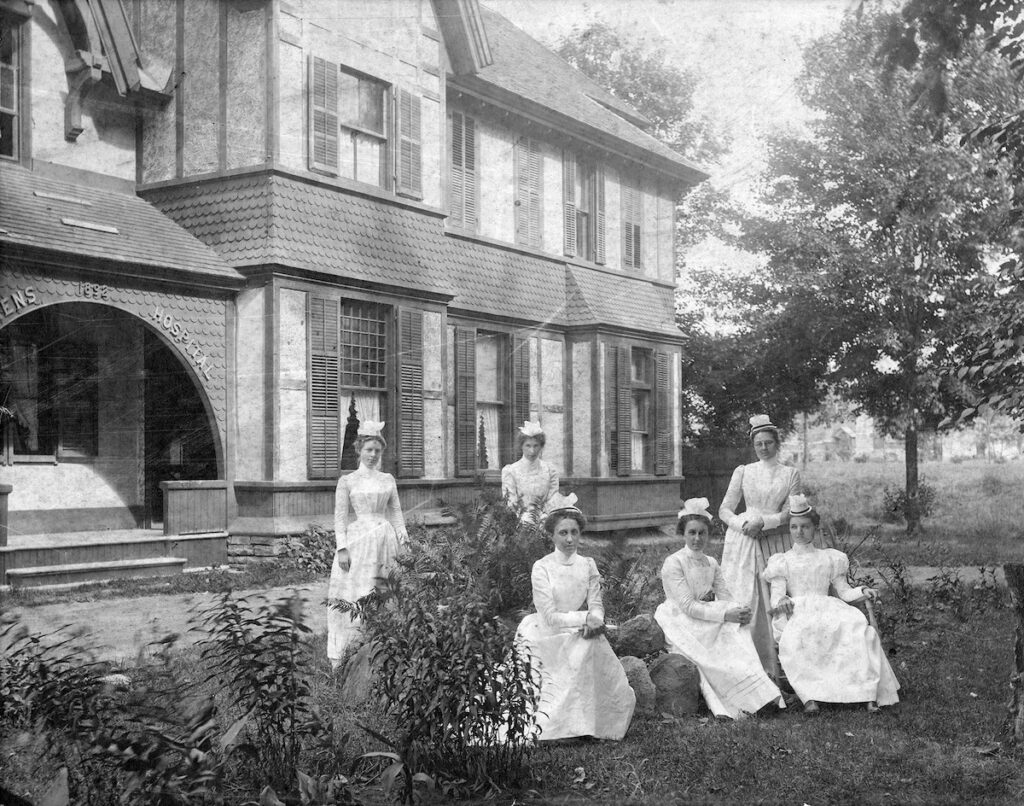
(Source: Bytown Museum)