
From the candidates – the answers to The Lowertown Echo and Sandy Hill IMAGE’s questions
The Echo and the Sandy Hill IMAGE collaborated to reach out to all six candidates for Ward 12 Rideau-Vanier municipal councillor with a series of questions. Answers appear in alphabetical order and may have been cut to comply with the word limit requirement. No replies were received from Eric Smith.
Meet the municipal candidates for Ward 12 Rideau-Vanier
Julie Fiala Chartrand
Julie Fiala Chartrand, Ph.D, is a proud Franco-Ontarian artist, museum curator and volunteer. Among her achievements, she piloted a free university project near Chandigarh, India, and hosted a dialogue about public safety on 30 red couches in Hyde Park, Leeds. She also worked as a housing consultant, was a board member for the Vanier Community Association, and the Chair of their Safety Committee.
Lyra Evans
Lyra Evans is a multi-award winning 2SLGBTQIA+ community leader for over 15 years, former non-profit executive director, and twice elected public school board Trustee. She has a diversity of lived experience, including being homeless for years as a teen, and overseeing large public budgets in excess of one billion dollars.
Brian James Paquette
I am an Ottawa native, martial arts instructor, entrepreneur, personal trainer, and youth mentor. As the owner of multiple academies, I’ve dedicated years to empowering people through fitness, leadership, and self-defence. My community work focuses on supporting youth and families while building confidence, resilience, discipline, and stronger, safer communities across Ottawa.
Stéphanie Plante
A proud francophone, Stéphanie has called Ward 12 home since 2004. She lives in Sandy Hill with her family. Stéphanie was a surrogate for a gay couple in 2017 and believes that LGBTQIA+ rights are human rights. Stéphanie is a basketball referee who loves coffee, audiobooks, reality TV.
Michael Karl Sewanaku
Born here. Lived in Ottawa Community Housing (OCH) on Bernard Street through high school and university, also stayed with my sister above Eastview Pizza in Vanier. My father relied on OCH on Rochester St. Earned three uOttawa degrees, then worked as labourer in Ft. McMurray before earning JD and MD.
Julie Fiala Chartrand
Julie Fiala Chartrand, Ph.D, is a proud Franco-Ontarian artist, museum curator and volunteer. Among her achievements, she piloted a free university project near Chandigarh, India, and hosted a dialogue about public safety on 30 red couches in Hyde Park, Leeds. She also worked as a housing consultant, was a board member for the Vanier Community Association, and the Chair of their Safety Committee.
Lyra Evans
I look around the ward, and see things are getting worse, not better. I have a long history of improving things, particularly for marginalized identities and amplifying other peoples’ voices. My experience as a formerly homeless teenager, followed by my working with homeless teens and youth at the Youth Services Bureau, have given me a great deal of insight into how to start to solve the problems affecting the neighbourhood. I have enjoyed bringing the concerns and needs of the community to the school board over the past 8 years, and want to carry that passion into the future.
Brian James Paquette
As a local small business owner, father and Ottawa native I have seen the incredible highs and lows of our ward. It has grown tremendously in both splendour, nightlife, arts, culinary offerings yet sadly also grown in homelessness, addiction and violence. I long for a Ward 12 where all are thriving and safe. Running for council is but one of several ventures I am undertaking to do my part to manifest this ideal.
Stephanie Plante
I have lived in Rideau-Vanier since 2004 and am raising my family here. This is my community, and I understand both what makes it special and the pressures our neighbourhoods carry. Since my election in 2022, we have accomplished a great deal together, from securing investments in parks, recreation and affordable housing to improving road safety and advancing the revitalization of the ByWard Market. We have also brought greater attention to challenges that have been allowed to fall disproportionately on downtown communities. I have the experience, relationships and determination to turn the work we started into lasting change.
Michael Karl Sewanaku
Over the past 10 years, homelessness and rents have become absurd, the OCH waiting list has become unacceptable, and OC Transpo became unreliable. Yet in Canada’s capital, where all federal MPs convene, every level of government has failed to act with urgency. Same politics, same problems. I want to bring a different approach. I’ll assemble the best team possible, calculate the true cost of homelessness in Rideau–Vanier, and demand adequate funding. If governments still refuse, I will live on the street in protest while using $1,900 of my monthly councillor’s salary to help someone else get off the street.
Julie Fiala Chartrand
I want to focus on stewardship to improve city services (OC Transpo, parks, culture facilities; recycling, solid waste management; the Social Housing Registry, and affordability; basic health and dental care). It is by addressing the needs of the most vulnerable that we begin to build a better world. We must deal with heavy topics like homelessness, mental health and addiction. Considering the bleakness coming from the USA, I think it is time for artists to contribute to building this better world. As Ottawa Life argues, we need to build communities – not just homes. A roof is simply not enough!
Lyra Evans
1) Homelessness, which is improved by matching the off-ramps from homelessness to the care and support necessary to get people out of the cycle of homelessness. Specifically, supportive or wrap-around housing for those who need it. 2) Affordability of housing, which is improved by increasing the vacancy rate through building more city-owned and affordable housing, and making it easier for individual owners to turn single occupancy homes into multi-residential units. 3) Transit, which is solved by increasing reliability through a spare driver and bus program, reversing cuts-by-inflation, and changing the expectation that it is 50% fares, 50% city funding.
Brian James Paquette
I believe we should be compassionate toward people who are struggling, uncompromising about public safety, and accountable to taxpayers. Public safety isn’t an either-or choice between policing and social services. We need effective enforcement when crimes are committed and effective treatment when addiction or mental illness drives the problem. We must respect people’s rights while protecting residents, businesses, and vulnerable people from violence, exploitation, and disorder. Compassion cannot mean abandoning public safety. I believe in safer streets, responsible spending, practical solutions for homelessness and addiction, and a government that listens and answers to the people it serves.
Stéphanie Plante
Sandy Hill and Lowertown are asked to absorb a disproportionate share of the city’s shelters, social services, traffic and public-safety pressures. These are compassionate communities, but compassion cannot mean expecting the same few neighbourhoods to carry responsibilities that belong to the entire city and region. We need to distribute housing and services more fairly across Ottawa, while improving the management, security and funding of existing facilities. I will continue pushing for permanent and supportive housing as an alternative to large emergency shelters, along with properly funded mental-health and addiction treatment. The downtown truck route is another longstanding injustice; I support the proposed eastern interprovincial crossing.
Michael Karl Sewanaku
The most urgent issues are homelessness, affordability and crime. You can see the issues by standing at Nelson and Rideau or speaking with local businesses. These problems cannot be solved with slogans. I will assemble the strongest team possible, gather reliable data and press all levels of government for the funding and cooperation needed for housing, prevention, treatment and public safety. Governments can’t claim to keep people safe by building jails while failing to build housing. If they still refuse to act, I am prepared to live in a tent in protest. This political nonsense must stop.
Lyra Evans
Solving addiction, especially when combined with homelessness, trauma, or mental health issues, is a complex, multifaceted problem. The closure of the supervised injection sites has turned every bus stop and street corner into an unsupervised injection site. We have seen an increase in needles on the streets, in people oblivious to the world around them, and in aggressive confrontations with vehicles and pedestrians. Part of the solution should be the city setting up wrap-around housing programs near public transit, but further towards the edge of the city to limit the interactions between the people who are actively trying to manage their addiction and those who have not taken that step yet. Part of the solution is the province stepping up and appropriately funding addictions programs.
Brian Paquette
Impacts of supervised injection service closures:
We need to make sure there is a real plan in place, not just move the problem somewhere else. We need better outreach, treatment, recovery, housing and crisis services, while making sure residents and businesses are not left dealing with everything on there own. We need to track what is working and what isnt.
Encampments:
We have to deal with encampments with compassion, but also with accountability. People need a pathway to shelter, treatment, housing and recovery. Just moving people from one park or street to another doesnt solve anything. At the same time, our parks, sidewalks and public spaces need to be safe and available for everyone.
Concentration of support services downtown:
Lowertown and Sandy Hill cant continue carrying such a large part of the burden. We need a more balanced approach across the city, working with the Province, service providers and other partners. The goal should be getting people the help they need without putting the entire responsibility on a few neighbourhoods.
Stéphanie Plante
The impacts of the closure of supervised injection services in Lowertown and Sandy Hill
We need reliable evidence about what happens to the local drug supply and surrounding communities when services close. That is why I brought forward a motion directing the City to work with Ottawa Public Health, Ottawa Police and other partners on wastewater monitoring for toxic drugs. It passed unanimously.
Wastewater surveillance can identify emerging substances and changes in drug use earlier than traditional reporting, allowing public-health officials, first responders and community organizations to respond more quickly. I will continue pressing the provincial and federal governments to provide appropriate treatment, withdrawal management and recovery services so that the consequences of their policy decisions are not simply downloaded onto downtown residents.
Encampments appearing in both neighbourhoods
Councillor Ariel Troster and I have discussed establishing an urban councillors’ caucus to examine issues that affect the core differently from the rest of Ottawa. Citywide service standards do not always reflect the density and intensity of downtown neighbourhoods.
For example, if the usual timeline for addressing an encampment is seven days, a shorter standard may be appropriate in a dense downtown park or beside homes, schools and businesses. Any response must comply with the Waterloo court decision by ensuring that people are offered suitable shelter or housing options. But once those options have been provided, residents should not have to wait a three to four weeks for an important public space to be restored.
The concentration of support services in the downtown core
Lowertown and Sandy Hill cannot continue to absorb services intended for the entire city and region. Every new proposal is often considered individually, without accounting for the cumulative impact of the shelters, drop-ins and crisis services already concentrated here.
I will continue advocating for a citywide distribution of supportive housing, treatment and social services. City funding, zoning and procurement decisions should include a neighbourhood-impact assessment that considers existing service concentration. Existing organizations must also be accountable for managing their properties and their effects on neighbours.
People need services, but those services do not all need to be located within a few downtown blocks.
Lyra Evans
The price of housing is largely a function of the vacancy rate. The higher the vacancy rate, the more available units, the more competition between landlords, the lower rents will become as each has to decide between carrying a property with costs but no tenants, or holding out for a higher rent. I have three proposals for the city of Ottawa as methods to help address the price of housing, each of which centre on increasing supply. The first is building more city-owned, non-profit or co-op housing. I would push the city to begin building a target of 1500 city-owned units per year by 2032. The second is to create a new permit requirement, that as a condition of constructing a building with 10 or more storeys, a fixed number of units be given to the city for use as affordable housing. This has the benefit of creating mixed income neighbourhoods, and giving the city some distribution for locations. Finally, the city should be reviewing zoning, parking minimums, and setback requirements to make it easier to allow individual property owners to build more intensive housing.
Brian Paquette
We need more housing at different levels, including affordable rentals, supportive housing and housing people can actually afford to buy. I support responsible development, but we also have to protect the livability of our neighbourhoods. Housing also needs to be connected to jobs, transportation, treatment, recovery and community supports.
We have to deal with encampments with compassion, but also with accountability. People need a pathway to shelter, treatment, housing and recovery. Just moving people from one park or street to another doesnt solve anything. At the same time, our parks, sidewalks and public spaces need to be safe and available for everyone
Stéphanie Plante
Rideau-Vanier already plays a major role in providing affordable housing, with almost 2,000 community-housing units. We are also adding approximately 160 affordable homes at 200 Beausoleil, and the City supported the Ottawa Community Land Trust’s acquisition of properties on Brant Street to preserve existing affordable rentals.
Because our ward is already highly developed and densely populated, we must focus not only on new construction but also on protecting the affordable housing we have. I want the City to pursue more strategic acquisitions with Ottawa Community Land Trust and non-profit providers before affordable buildings are sold, demolished or converted into more expensive housing.
Affordable and supportive housing must also be expanded across Ottawa. Ward 12 should continue doing its share, but it cannot be expected to meet the entire city’s housing needs. If asked, I would be pleased to continue serving on the Ottawa Community Housing board and advancing this work.
Lyra Evans
Two centuries is a long time, and the character of a place will naturally change given such tenure. I fondly remember the market as a collection of stalls, a touch of chaos, and a bustling hub within the city. I envision the market better than it is today, back to the town square, buskers, and farmers market of my memories. The space that people from across the city come to visit, and the people who live in and nearby get their produce from the stalls. With eclectic shops, shopkeepers, and wares; a space for people to visit, to take their kids, and to have a good time.
The major barrier to this becoming a reality is the consistently unaddressed mental health and addictions crisis on our streets. For too long, the city and the province have not addressed the healthcare needs of the Market, and the local community is suffering accordingly. The solution has to involve solving that crisis.
Brian Paquette
My vision is pretty simple. The Market should be safe, clean, busy and welcoming for residents, businesses and tourists. The 200th anniversary in 2027 is a huge opportunity to bring people together and build something that lasts beyond the celebration. We need better safety, cleaner public spaces, support for local businesses, tourism and more family friendly activities year round.
Stéphanie Plante
My vision is a ByWard Market that welcomes everyone: residents, families, visitors, businesses and people of every income. It should feel like a neighbourhood and public market throughout the day, not only an entertainment district at night. I hosted a very successful FIFA Final Watch Party on July 19 that included the ambassadors of Spain and Argentina and over 1000 people from all over the city came to the Byward to celebrate.
An important part of that transformation is the planned conversion of the Shepherds of Good Hope property from an emergency shelter into permanent supportive housing. Housing people rather than cycling them through a shelter will provide greater stability for residents and the surrounding community.
For the Market’s 200th anniversary, I would also like to launch an initiative to plant 200 trees, with an emphasis on beautiful flowering species such as magnolias and cherry blossoms where conditions permit. This would create shade, improve the tree canopy and give the Market a living legacy from its bicentennial.
I also initiated the application to have the ByWard Market recognized as a federal heritage site. I hope to have more news to share soon.
Lyra Evans
As an environmental chemist, there are two conversations, one is adaptation to the changing climate, the other is reducing our contribution to climate change. On mitigation: renewal of the sewer infrastructure to accommodate heavier rainfalls and faster snowmelt; public information campaigns about ticks moving further north; preparing for disasters, such as floods, wildfires, and wind before they happen; ensuring city spaces have the ability to be adequately cooled during heat waves; and preparing for drier summers and potential drought.
On reduction: the city should be leading by example by investing in renewable infrastructure for city owned buildings, such as solar and geothermal heat pumps, proper insulation, minimizing unnecessary light pollution and light usage at night, and limiting unnecessary water usage. Finish the electrification of the public transit system, and support creation of public electric charging stations. The city should also focus on native plants for green spaces to support local pollinators and ecosystems and support community gardens growing food.
Brian Paquette
My approach is practical. We need to prepare our neighbourhoods before the next major storm, flood or heat event happens. That means better stormwater management, more trees, cooling spaces and stronger infrastructure. We should be looking at where the biggest risks are and putting our resources there first.
Stéphanie Plante
Rideau-Vanier is home to Ottawa’s first sponge park, at Carillon Park. A sponge park uses trees, plants, soil and specially designed landscaping to absorb and temporarily retain stormwater. This reduces pressure on the sewer system and helps protect surrounding properties during increasingly intense storms.
I want to build on that work through more sponge parks, tiny forests, shade trees and green infrastructure. My proposal to plant 200 trees for the ByWard Market’s 200th anniversary would be another practical contribution.
Transportation is also central to climate action. I have supported bus-only lanes on Rideau Street and Montréal Road, and I want to identify additional corridors where transit priority can improve reliability. We also need a safer, better-connected cycling network so that walking, cycling and transit are realistic choices for more residents.
Lyra Evans
Crime in our neighbourhood comes from two major sources. Addiction/mental health and poverty. Mental health crises, poverty, and addiction are complex problems requiring intersectional solutions, not problems the city can simply police our way out of. Over the last number of years, we have seen a sharp increase in “porch pirates”, thefts, vandalism, and trespassing. Part of this is what experts term drug seeking behaviour; breaking into things or stealing to fuel an addiction. The province needs to be building and funding adequate healthcare supports for people who are struggling, particularly those who end up homeless as a result.
On poverty, the problem is equally complex; and has historically involved building communities that prosper, have economic stability, and where people see a realistic path to building a better life than recurring petty theft can provide.
Brian Paquette
Safety starts with being visible and actually being present in the community. We need targeted policing where crime is happening, better lighting, cleaner streets, safer transit and better coordination with social services. And we need to measure the results—crime, violence, theft, response times and disorder complaints—so residents can see if things are actually getting better.
Stéphanie Plante
Living downtown can be stressful right now. I live here too, and I see and experience many of the same conditions residents describe to me.
Community safety requires several approaches. I supported and helped secure the expansion of the 211/ANCHOR non-police crisis response so trained professionals can respond to appropriate mental-health and substance-use calls. This also allows police to focus on violence, trafficking and serious crime.
I have raised concerns directly with Health Canada about the diversion of hydromorphone pills associated with its safer-supply pilot and the impact this was having in the surrounding community. Governments must evaluate these programs honestly and respond when unintended consequences emerge.
I also support the CORE policing model, which puts officers on foot in key downtown locations where they can build relationships, respond more quickly and address persistent criminal activity. Finally, converting the Shepherds of Good Hope from a shelter into permanent supportive housing will help address some of the instability concentrated in Lowertown.
Compassion and accountability are not opposites. We need appropriate care for people in crisis and clear consequences for criminal behaviour that harms others.
Lyra Evans
The city has genuine heritage properties, buildings who housed prime ministers of Canada, architectural beauties like the Chateau Laurier, and world historical sites like the Rideau Canal. It also has other buildings that have been put on the historical lists, but which do not rise to the caliber of the other group. In some cases, the heritage list has been used to try and protect neighbourhood character, instead of the intended purpose of preserving sites of major historical value. We can preserve genuine history while making it easier for housing or updates to be built, without detrimentally impacting neighbourhood character.
For example, Broadview (A school in Westboro) was declared a heritage building based on the exterior brickwork, but was previously declared unusable as a school due to not meeting modern school based needs such as number and size of washrooms for the student population, safety hazards like asbestos, and size of classrooms. This has resulted in an unusable building sitting empty, and a new school being built on a now-smaller plot of usable land. The brickwork in question is the same as the school next door.
Brian Paquette
I believe we can protect our history without stopping our neighbourhoods from moving forward. Heritage matters, but we also need housing, businesses and communities that work today. When development and heritage are in conflict, we need an honest conversation about what is worth preserving, what can be changed and what the community benefit is.
Stéphanie Plante
As vice-chair of the Built Heritage Committee, I do not believe heritage conservation and development must always be treated as competing goals. We need housing and growth, but we can often achieve them through adaptive reuse, sensitive additions and designs that preserve the features giving a building or neighbourhood its character.
The Province must provide municipalities with stronger tools and financial mechanisms to preserve heritage properties. We also need better ways to hold negligent owners accountable when they allow significant buildings to deteriorate and then use that deterioration as an argument for demolition.
Not every building can be preserved unchanged, but demolition should not be the default simply because responsible maintenance or thoughtful design requires more effort.
Lyra Evans
The role of councillor is to be the voice of the community. A councillor is not required to be silent on issues impacting their constituents, and as a councillor I intend to attempt to be collaborative, working with elected officials of any stripe to achieve the best outcomes for our neighbourhoods. If being collaborative does not work, I intend to be outspoken. When another level of government is making a decision that would have a detrimental impact, such as a provincial government implementing healthcare cuts impacting the Montfort, cancelling or delaying the proposed 6th crossing, or inadequately funding Ottawa’s public transportation, I would be outspoken about that.
Brian Paquette
If something is affecting Ward 12, I dont believe the answer should be “not our problem” just because it belongs to another level of government. As a coach, if there is a problem, I find out who needs to be at the table, bring people together and keep pushing for a solution. Then I report back to residents and hold people accountable for getting results.
Stéphanie Plante
I reject the idea that municipal councillors have no role simply because another government holds the formal authority. We may not make the final decision, but we can organize, advocate, bring governments together and make it politically difficult for local impacts to be ignored.
The proposed sixth interprovincial crossing to help with our truck issue downtown is a clear example. It requires federal and provincial leadership, but I have worked persistently with senior government officials, City staff and political representatives to build support for the project. That advocacy has helped move the discussion forward, and partners across governments have acknowledged my role.
Residents do not care which order of government’s name appears on an organizational chart. They want their representatives to work together and solve the problem. My approach is to identify who has the authority, bring the right people to the table and keep pushing until there is action.
MORE ELECTION INFO
Vote! Votez!
- Advance Voting Day: October 16, 10:00 a.m. to 8:00 p.m.
- Election Day: October 26, 10:00 a.m. to 8:00 p.m.
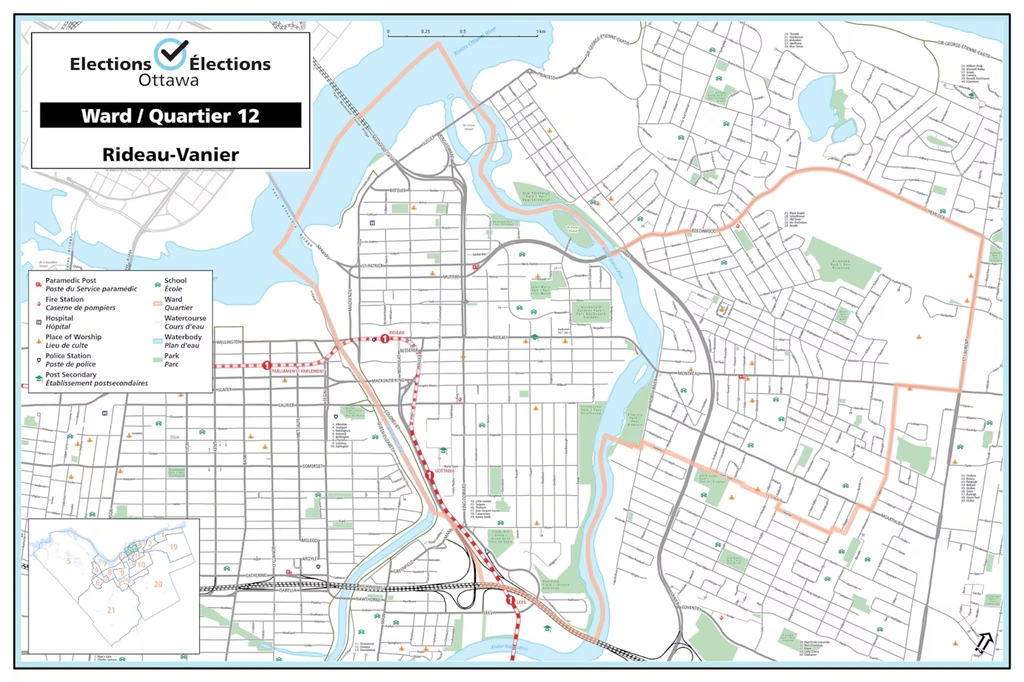
Find your voting location here: https://elections.ottawa.ca/VotingLocation/VotingLocation
For more coverage of Ward 12 candidates:
CTV News Meet the Candidates coverage: www.ctvnews.ca/ottawa/article/meet-the-candidates-for-councillor-in-ward-12-rideau-vanier/
OPEG (Ottawa Public Engagement Group
The non-partisan civic organisation OPEG (Ottawa Public Engagement Group) asked candidates 2 questions: 1) Articulate a public position on engagement – not a generic statement about ‘listening to residents’ but how and when residents will have influence over the decisions that affect them); 2) Explain how residents will influence decisions – not just be consulted but influence. Replies from mayoral and municipal councillor candidates can be found on their website: https://www.ottawapublicengagementgroup.ca/election-2026/responses